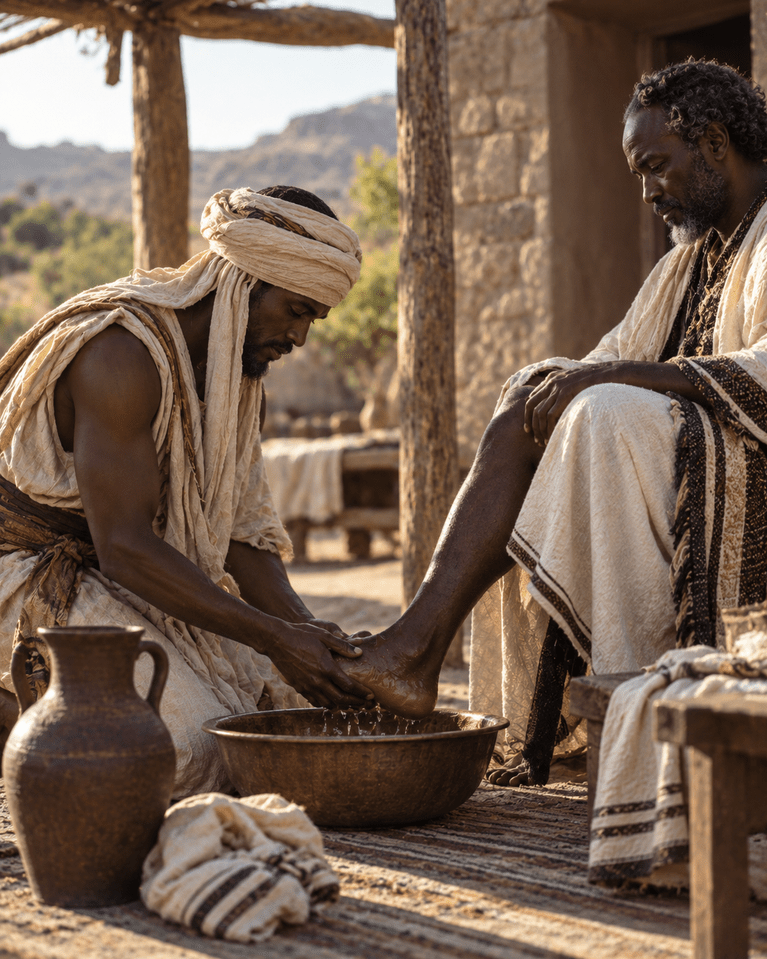
Metanoia: The Reorientation of the Mind

Metanoia is the Koine Greek word translated in the English Bible as repentance. The word is often explained as meaning a deep sorrow or contrition that leads to a change of one’s mind and life. It is a word that carries the most invaluable and the most powerful message in the Christian teachings; it is the heart of the process of transformation. Metanoia itself does not have any merit in itself; neither are we saved because of it. Repentance is necessary without being meritorious.
Before we dwell at length on this subject, it is crucial that we clarify a few things. I mentioned earlier that repentance is often defined as being a deep sorrow or contrition that leads to a change of mind and life; the word itself does not mean sorrow or contrition, though these may accompany or lead to repentance. It clearly points to a change in how the person sees, evaluates, judges, values, chooses, and consequently lives. Therefore, the word conveys a concept of mental reorientation.
In my previous expositions, I briefly spoke about mental reorientation, specifically in the context of mental transformation and the process of mental governance. In this exposition, we will look into one of the most crucial underlying principles of the process of transformation and self-government.
Orientation

As a child, I was born and raised in a belief system handed down from generation to generation, an old system. I never really got an opportunity as a child to question the validity of this belief system; I accepted it as my religion, a way of life. It provided me with a perception, a lens through which I saw life, a criterion by which I evaluated other persons and experiences, a standard by which I judged others and their experiences, a set of values and standards by which I made choices and, as a result, lived my life.
My mind was oriented towards my ancestors, my people, and myself. Everyone else was either my obstacle or my stepping stone to glory. Of course, as a teenager and as an adult, I modified my system. I lost some of the principles, values, and standards, and added some of my own, based on my own experiences and education. Important to note, I did not discard the whole system; I just modified it according to my interest and liking.
A person can change opinions, habits, vocabulary, education, even religion, while the same governing principle remains at the centre. Therefore, I remained orientated towards the same direction, only that this time, self took more preeminence.
The truth is that though this is not the universal orientation of mankind, the underlying principle is precisely the same. We all have a mental orientation—a governing direction of the mind toward what it perceives, values, trusts, seeks, and chooses. The sad reality is that not all ways are true and good ways. One may argue that each one has his own path to walk and his own experience to obtain. Though this is true in the sense that each man and woman will scribe their own experience, it is not true that the way of optimum life and fulness depends on each individual. My experience may be uniquely mine, but whether the path itself leads toward truth, life, and fulness is not created by my experience.
Set Your Sail

When you have followed a particular course for a long time, it becomes almost impossible to change direction. The truth is, every man must set his own sail at some point. Regardless of the gales and the winds of the sea, each must learn to direct his own ship and navigate the seas of his own life. Having drifted off for years in a particular direction, I became so rooted in my ways; I became convinced of my own lies; I became settled in my beliefs. In that condition, it was extremely difficult to accept any other way, not to mention just listening to a different theory or philosophy of life. I was a slave to a system of beliefs that had no benefit to me. I could see my life slipping away, and yet I could not save myself.
At some stage, as a criminal, a drug addict, and an alcoholic, I had a desire growing in my heart to turn another way; I just did not know any better way. It was as though there was someone working within me to will a different path, a path I knew not. Yes, I made an effort to veer another way. I could modify my behaviour and overcome some habits, but without a reorientation of the mind, there was no real change. I did not have the ability to genuinely experience metanoia. The real problem was my mental orientation. Until one is yielding to the divine agency that seeks to reorient the mind, he or she will continue to drift with the current, helpless and hopeless, completely at the mercy of the seas and the winds, which drive the ship wherever they will.
Our greatest enemy is our incorrect interpretation of reality—the distorted perception of what constitutes truth and life. A distorted interpretation of reality affects what we perceive as true, what we judge as good, what we feel, what we choose, and consequently how we live. This was my greatest prison. My false judgment led to bad choices and a refusal of mental reorientation. Only when I was convinced of the truth, my heart was made willing to turn away from my distorted perception of truth and life, and my conscience was awakened and made to see the error of that distorted perception, then only was I set free from the bonds of the lies in which I was kept.
Reorientation

Repentance consists of five steps. The first step is foundational and essential. That is, one must acknowledge that there is only one who is the source of existence and the source of truth. Therefore, one must accept and believe in the one and only true God and Christ whom He has sent.
Of course, one ought not to accept blindly the claim that this God is the only true God, the only source of existence, and the source of truth, but based on the ample evidence that we find all around us—that is, in nature, in archaeology, in sacred history, in prophecy, and in the personal experiences of those who have walked with Him. Unfortunately, this exposition is not intended to present this evidence. Since that is the case, we shall continue to the second step.
The second step is intellectual and moral awareness of truth. It is crucial and imperative that one must acknowledge the truth as it is in Christ—not our own concept of truth, but the absolute truth—to have a clear understanding of what constitutes reality.
This brings us to the how: no man nor woman can, in and of himself or herself, come to the acknowledgment of truth lest it be brought to the mind by Christ, for repentance is a gift of God given through Christ. It is He [Christ] who awakens the mind to truth in His life and Word through the Spirit.
The third step is conviction. This requires humility, manifested through a teachable and submissive spirit to the convincing testimony of the Word concerning God, concerning humanity, and reality. One must accept the truth of God’s Word as driven home by the Spirit of God and admit that he has been amiss concerning truth and morality. As the Spirit brings home the sinfulness and deformity of one’s ways, conviction deepens into godly sorrow and contrition—not merely sorrow for the consequences of wrongdoing, but sorrow for the wrong itself. The heart begins to see the ugliness of sin and the distorted character of the life that has been lived. This sorrow is not repentance by itself, but, as Paul declares, “godly sorrow worketh repentance.” The mind that has been convinced of truth is thus brought to feel the weight of its error, and the heart is prepared to turn away from it.
The fourth step: we must yield to the appeals of God’s Word and His Spirit. We must turn from our false ways of life, from the lies we have been fed, cultural conditioning, and misleading education. We must turn towards God and have faith in Christ.
The fifth and last step is application. Many suppose that the change of life occurs without any active cooperation on our part, that the reorientation of the mind and the change of life require nothing from us. Well, human effort must cooperate with divine power, meaning human effort is not negated by divine power. We must apply the truth in our lives, and that requires the effort to resist past propensities and tax our minds and our bodies to apply the truth, regardless of the waves of habits and influences of the past.
A Reorientated Mind

Metanoia, then, is far more than sorrow for the past or a mere modification of behaviour; it is the reorientation of the whole mind towards God and the truth as it is in Christ. The mind that once interpreted reality through the lenses of self, culture, appetite, habit, and falsehood is brought face to face with truth; the conscience is awakened, the understanding enlightened, the heart persuaded, the will yielded, and the life redirected. Yet Christ stands at the beginning, the centre, and the end of this entire work. “Christ is the source of every right impulse.”
We cannot of ourselves change the heart, but we can yield the will to Him; and when the will is surrendered, He works within us “to will and to do according to His good pleasure.” Therefore, human effort does not take the place of divine power, neither does divine power destroy human agency; the two meet as the soul willingly cooperates with Christ. Then truth ceases to be merely something known and becomes a principle lived. Old interpretations of reality give way to the mind of Christ, old values are displaced by heavenly ones, old habits are resisted, and a new direction begins to govern the life. “If the heart has been renewed by the Spirit of God, the life will bear witness to the fact.”
What beauty there is in such a life! The mind is no longer left to drift helplessly with every current of appetite, culture, education, habit, and circumstance, but is anchored in truth and directed towards God. Christ becomes our wisdom, our strength, our righteousness, and our everlasting Helper; and as the mind dwells upon His love, His purity, His humility, and His matchless character, it is progressively transformed into His likeness. This is the great object of metanoia: not merely that man should think differently, but that, through Christ, he should see differently, value differently, choose differently, and finally live differently. The sails are turned, the course is changed, and the soul that once drifted away from God now journeys towards Him, looking unto Christ as both the Author of the reorientation and the power by which the new course is maintained.
Bibliography
The Holy Bible. King James Version.
Matthew 3:2, 8; Mark 1:15; Luke 13:3; John 6:44; John 8:31–32; John 14:6; John 16:8, 13; John 17:3; Acts 5:31; Acts 11:18; Acts 17:30; Acts 20:21; Acts 26:20; Romans 2:4; Romans 3:20–28; Romans 5:1; Romans 12:2; 2 Corinthians 3:18; 2 Corinthians 5:17; 2 Corinthians 7:9–11; Ephesians 2:8–10; Ephesians 4:22–24; Philippians 2:12–13; 2 Timothy 2:25–26; Titus 3:3–7; Hebrews 6:1.
Thayer, Joseph Henry. Thayer’s Greek-English Lexicon of the New Testament. Entries for μετανοέω (metanoeō), Strong’s Greek 3340, and μετάνοια (metanoia), Strong’s Greek 3341.
Clement of Rome. First Epistle to the Corinthians. Chapters 7–8.
Irenaeus. Against Heresies. Book III, Chapter 20.
Luther, Martin. Preface to the Letter of St. Paul to the Romans.
Luther, Martin. The Freedom of a Christian.
Melanchthon, Philip. The Augsburg Confession. Articles IV, “Of Justification”; XII, “Of Repentance”; and XX, “Of Good Works.”
Calvin, John. Institutes of the Christian Religion. Book III, Chapter 3, “Regeneration by Faith. Of Repentance.”
Calvin, John. Institutes of the Christian Religion. Book III, Chapter 11, “Of Justification by Faith.”
Calvin, John. Institutes of the Christian Religion. Book III, Chapter 15, “The Boasted Merit of Works Subversive Both of the Glory of God, in Bestowing Righteousness, and of the Certainty of Salvation.”
White, Ellen G. Steps to Christ. Chapter 3, “Repentance.”
White, Ellen G. Steps to Christ. Chapter 5, “Consecration.”
White, Ellen G. Steps to Christ. Chapter 7, “The Test of Discipleship.”
White, Ellen G. “Christ Gives Repentance.” The Signs of the Times, August 11, 1890.
White, Ellen G. Faith and Works. Especially the sections dealing with repentance as the gift of Christ, justification by faith, and the proper relationship between faith and works.
Waggoner, Ellet J. Christ and His Righteousness. Pacific Press Publishing Company, 1890. Especially “Acceptance With God,” “The Victory of Faith,” “Bond Servants and Freemen,” and “Practical Illustrations of Deliverance From Bondage.”
Waggoner, Ellet J. “How Righteousness Is Obtained.” The Present Truth, March 24, 1892.
Jones, Alonzo T. “Notes on the International Lesson. Acts 20:17–27.” The Signs of the Times, December 18, 1884.